"Never doubt that a small group of thoughtful, committed citizens can change the world; indeed, it's the only thing that ever has." Margaret Mead, American anthropologist, 1901-1978
Forestry authorities in China's north western Shaanxi Province have launched an ecological corridor programme.
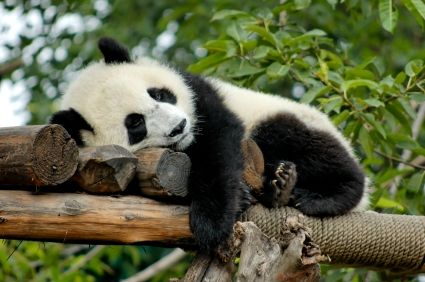
The programme will connect fragmented giant panda habitat, making it easier for pandas to make their way across the region safely. Six such corridors will be built by 2027 using bridge construction and road culvert clearance.
In addition to building the corridors, bamboo trees are to be planted and vegetation restored along the route. This means that the pandas willl have plenty to eat along the way.
Human activities, road traffic and hydropower station construction meant that panda habitat was being divided into six parts in the Qinling area - it was hard for pandas to connect and move about.
Research shows that about 345 pandas live in the Qinling area. May there be many more!
Useful information and ways to help pandas
US charity Pandas International is busy working hard to help with panda conservation in China.
″Endangered means we have time, extinction is forever.″
Butterfly Conservation sent my husband and I information about the work they did to save the Small Blue Butterfly and it makes very interesting reading.
I thought I’d share how they did it with you. They are hoping to repeat the success of the Small Blue in the West Midlands with other declining butterflies and moths.
Here’s the conservation journey Butterfly Conservation took:
1. Identify the problem
So by 2009, the Small Blue had become extinct in 4 counties in the West Midlands. In Warwickshire, it’s numbers had gone down by 87%. Here, recorders could only find 3 colonies left.
2. Research declines
The Small Blue lays its eggs on flowering Kidney Vetch. But site surveys for the Small Blue showed they were becoming too overgrown with scrub for new Kidney Vetch plants to establish themselves.
3. Determine Solutions
These were:
To remove scrub
To test methods of creating new habitat to encourage Kidney Vetch to germinate
To sow Kidney Vetch seed or plant plug plants
4. Take Action!
Since 2009, Butterfly Conservation has….. (drum roll please…)
Cleared 56 hectares of scrub
Created 27 butterfly banks
Dug 12 scrapes
Planted a whopping 13,000 Kidney Vetch plugs
Sowed 34kg of seeds over 60 sites
4. Do the next steps
The charity has recruited volunteers to monitor Small Blue numbers and help maintain and restore habitat. This will help wildflowers and butterflies to flourish.
5. Yippee!! This has all been successful
The Small Blue Butterfly liked the habitat improvements, colonizing restored habitat on occupied sites AND moving back to former sites. It even went into areas it hadn’t been before
By 2016, the Small Blue had spread to 19 sites. This was a six-fold increase in numbers in only 7 years!
But there's more. In this project, Butterfly Conservation says the Small Blue has been a ‘flagship’ or ‘umbrella’ species. The reasons for this is that other butterflies, moths and invertebrates have been helped by improvements to the habitat. The Grizzled Skipper, the Dingy Skipper, the Chalk Carpet moth and three of Warwickshire's rarest bumblebees all benefited. Which just goes to show that conservation projects don't just help one species - they can help a good many.
And now...
So now it’s hoped that other butterflies can be helped in the same way. Our changing climate is one factor, but research is taking place to find out why and then plan a way forward to reverse these declines.
You can help today by donating to help the High Brown Fritillary. It was once found in woodland clearings in much of England and Wales.
Since the 1970s, its distribution has declined by 96% and it now only remains in Exmoor, Dartmoor, Morecame Bay Limestones and South Cumbria LowFells and the Glamorgan Brackenlands.
3 ways to help butterflies generally
Plant a pot for pollinators in your garden – you only need space for a pot, you don’t need acres and acres
Volunteer for your local Butterfly Conservation branch
Have a good look round their website to look for a way to help
Although they are asking people in Worcestershire to do this, I thought, what a brilliant idea - and so I wanted to let everyone know about it in the hope more people would follow suit wherever they are and pledge a patch for wildlife!
The Worcestershire Wildlife Trust is celebrating its 50th birthday and it now has 75+ nature reserves across Worcestershire. They describe them as "stepping stones in the landscape" - I love that description. And they are asking people to join the dogs so that wildlife can move through safely.
Wildlife all over the world need wildlife corridors to help them move from one place to another and these are vital to help them reach everything they need to survive and thrive.
Ideas of how you can pledge a patch are... (and no, you don't need a garden)...
Fill a window box with nectar and pollen rich plants
Attach a bug box to the wall of your house
Leave a 1m by 1m square of grass longer so that daisies can grow for the bees
Put up a nest box for birds
Plant a pollinator patch in an area of land - businesses could easily do that
Bring your neighbours together and ensure that hedgehogs can get from one garden to another easily
Join up with locals to turn an unused patch of land into an areas for butterflies
Create a small pond for frogs and toads
Offer to manage a local verge and fill it with wild flowers - just sow wildflowers around it and don't mow it so often
So there's plenty everyone can do wherever you are. 80 peole have already signed up to the Pledge a Patch initiative and you can find out more from their website here.
Both sites provide suitable habitat for wintering water birds such as the lapwing, golden plover, brent geese. And they are an integral part of a continuous network of designated coastal habitats extending north from the Thames Estuary to the Colne Estuary.
The East coast used to be full of vibrant wildlife but human claims for agriculture, together with the forces of nature (coastal erosion and rising sea levels) have taken their toll.
The new status of both sites have recognised the importance of new mudflats and saltmarsh to offset the losses over the last 400 years.
The Government sees this protection as a vital way to achieve their 25 year Environmental Plan, and the thing about protecting the aforesaid area is that it is next to the RSPB’s Wallasea Island Wild Coast project.
The RSPB is working with partners such as Defra and the Environment Agency to create more coastal habitat for people and nature.
Approximately 95 per cent of the area of our Sites of Special Scientific Interest and about 60 per cent of the total area of our most important or ‘priority’ wildlife habitats is now in good condition for wildlife or has management in place to restore its condition.
The Dee Estuary is bursting with wildlife, including hosting avocets, egrets, harriers, noisy redshanks, swallows and swifts.
Since 2011 the RSPB has established management on approximately 130,000 hectares of land to create new wildlife-rich habitat in the wider countryside.
On World Lion Day (the 10th August), it’s great to announce a really exciting piece of news for wildlife conservation.
There’s a really fantastic opportunity for business to make a difference and have a real impact on wildlife.
Drum roll please for….. The Lion’s Share Fund!
You may have heard of The Lion’s Share. If you haven’t, let me tell you more. It’s an initiative which is aiming to transform the lives of animals around the world by asking advertisers to contribute a percentage of their media spend to conservation and animal welfare projects.
I am really excited by this initiative. The hope is that $100 million a year will be raised within 3 years. The money will be invested in a range of animal conservation and animal welfare programmes, to be implemented by the UN and civil society organisations.
The Lion’s Share is working to contribute to the UN’s Sustainable Development Goals, which are aiming to end poverty and project the planet. Goal 14, Life Underwater and Goal 15, Live on Land, involve supporting animals and helping to conserve their key habitat.
The UNDP (that’s the United Nations Development Programme) will host the fund. A joint steering committee will take decisions on priority programmes. Money raised will go into creative, game-changing solutions which focus on achieving real impact for the animals and their habitats.
Ambitious for sure - but if the top 10 advertisers alone were to participate, this would bring in a staggering $47m each year alone!
Partners in the fund will contribute 0.5% of their media spent to the fund for every advert they use which has an animal in it.
And cartoon animals will count as well. So if your company has an ad with a cartoon animal in it, they can participate!
Mars is the first advertising partner. It will sit on the executive and steering committees of The Lion’s Share and encourage other businesses to get involved.
Worldwide advertising network BBDO and leading measurement and data analytics company Nielsen are also involved. BBDO is contributing the benefit of its experience in advertising, whilst Nielsen will ensure that companies are contributing correctly.
The Lion’s Share Fund has a website, and a very helpful FAQ page. This answers a number of questions which spring to mind – how can we be sure the money goes to where it should, for instance. (Nielsen will watch that side of things like a hawk.) And 93% of the funds raised will go to the animals that need it.
Rob Galluzzo, founder of FINCH, initiated the idea with Christopher Nelius, a film director. Galluzzo says that 9 out of 10 of the most popular animals seen in commercials are endangered or threatened and they don’t always get the support they deserve.
FINCH have partnered with Clemenger BBDO to bring this initiative to life.
The fund was launched in Cannes at the Cannes Lions International Festival of Creativity, by UNDP Goodwill Ambassador and actor Nikolaj Coster-Waldau, who said quite rightly that it is our responsibility as people to safeguard all life on our planet. Coster-Waldau plays Jamie Lannister in the Games of Thrones.
So how can you help?
Well, if I see an advert with an animal in it, I'm going to let the advertising company know about the The Lion’s Shares Fund. It was only launched recently in June 2018, so they may not know of it yet.